
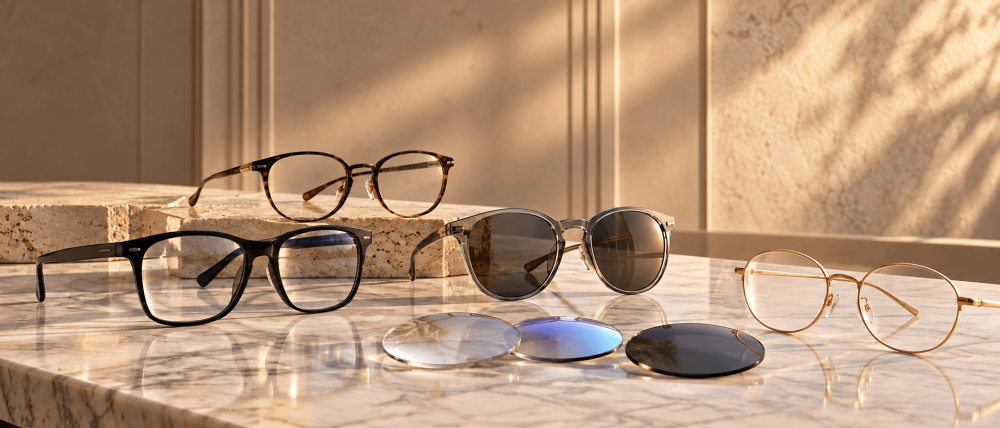
Choosing the right prescription lenses is just as important as choosing your eyeglass frames. Lenses are the essential component that provides clear vision and greater comfort throughout your daily activities. Whether you wear glasses for working on a computer, reading, driving, or moving between indoor and outdoor environments, choosing the right type of lenses can make a difference in your everyday experience.
With the wide variety of prescription lens types and advances in lens technology, you can now choose lenses that suit your needs and lifestyle. In this guide from Okyali, we help you explore the main types of prescription lenses and their benefits, compare the available options, and review prescription lens prices in Saudi Arabia for 2026 so you can make an informed purchasing decision.
Types of Prescription Eyeglass Lenses
1. Single Vision Lenses
Single vision lenses are among the most commonly used types of prescription eyeglass lenses. They are designed to correct vision at a single distance, whether for distance or near vision.
They are suitable for people with nearsightedness (myopia) or farsightedness (hyperopia).
Key Benefits:
- Clear vision at the distance specified in the prescription.
- Suitable for everyday use.
- Generally more affordable than progressive lenses.
Prices on the Okyali website start from 500 and vary depending on additional features, such as anti-reflective coating.
2. Progressive Lenses
Progressive lenses combine distance, intermediate, and near vision correction in a single lens, with a gradual transition between viewing zones and no visible dividing lines.
They are suitable for people who require different prescriptions for different viewing distances, particularly those who experience difficulty focusing on nearby objects as they age.
Their main advantage is the ability to switch between viewing distances without changing glasses. However, they are generally more expensive due to their complex design and precision manufacturing, and they may require an adjustment period.
Note: Progressive lenses are currently not available at Okyali.
3. Blue Light Lenses
These lenses contain filters that reduce the transmission of some blue light emitted by various sources, including digital screens.
Computer and smartphone users who want an additional blue light filtering feature may prefer these lenses. However, there is no strong scientific evidence confirming that they prevent eye damage or relieve screen-related eye strain.
It is important to distinguish blue light filtering from anti-reflective coating, which reduces reflections and glare on the lens surface and helps improve visual clarity.
4. Photochromic Lenses
Photochromic lenses are relatively clear indoors and become darker when exposed to ultraviolet (UV) light outdoors. They gradually return to their lighter state when UV exposure decreases.
They are suitable for people who frequently move between indoor and outdoor environments and want to reduce the need to switch between glasses.
One of their main advantages is their automatic adaptation to changing light conditions. However, the speed of the color change and the level of darkening vary depending on the lens type and temperature.
Available as an optional upgrade to prescription lenses for an additional 190.
5. Reading Lenses
Reading lenses are designed to improve visual clarity at close distances, such as when reading books, using a smartphone, or reviewing documents. They are a suitable option for people who have difficulty focusing on nearby text, particularly as they get older.
Reading lenses are available in different magnification strengths to suit individual needs. The appropriate strength can be selected based on vision measurements and intended use.
Key Benefits:
- Help provide clearer vision of nearby text and details.
- Suitable for reading and tasks that require focusing at close distances.
- Available in a variety of magnification strengths.
- Can be fitted into compatible eyeglass frames.
Reading lenses are available at Okyali for 200, with the option to select the appropriate magnification strength from the available choices.
Explore Reading Lenses at Okyali.
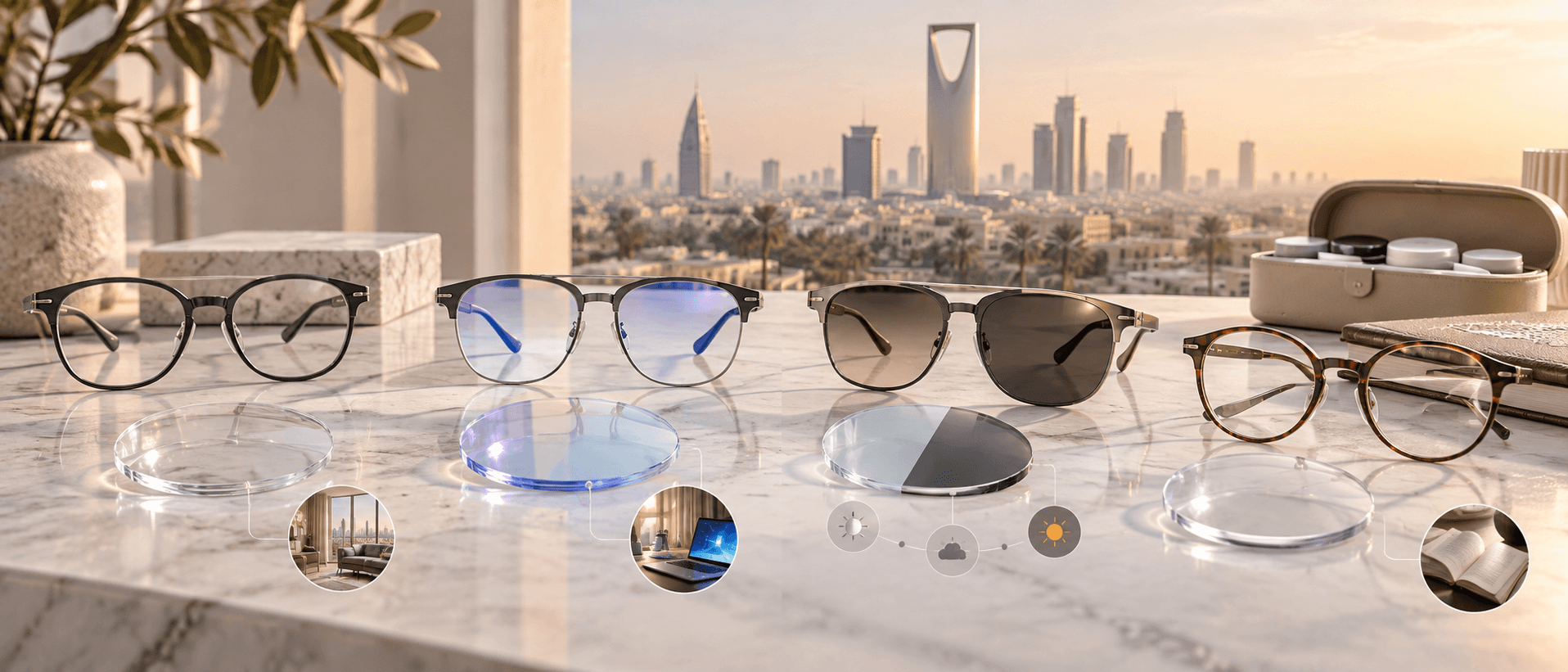
What Is the Difference Between Single Vision, Progressive, and Photochromic Lenses?
The main difference lies in the function of each lens type:
- Single Vision Lenses: Correct vision at a specific distance, either near or far.
- Progressive Lenses: Combine multiple viewing distances in a single lens.
- Photochromic Lenses: Change their tint in response to light and can be combined with suitable prescription lenses.
Therefore, photochromic technology is not a substitute for vision correction. Instead, it is an additional feature that can be selected according to individual needs.
How to Choose the Right Prescription Lenses
Choosing the best prescription lenses depends on your daily activities and the results of your eye examination.
- For everyday use: Single vision lenses are suitable if you need vision correction at one distance.
- For computer work: Make sure your prescription is accurate and consider an anti-reflective coating. You can also choose blue light filtering based on your preference.
- For indoor and outdoor use: Photochromic lenses are a practical option for changing lighting conditions.
- For near and distance vision: Progressive lenses may be suitable after consulting an optometrist.
An eye examination and accurate prescription measurements remain essential steps before purchasing prescription lenses.
What Factors Determine the Price of Prescription Lenses?
The cost of prescription lenses is influenced by several factors, including:
- Lens Type: Single vision lenses and progressive lenses have different costs.
- Prescription Strength: Higher prescriptions may require special lens specifications.
- Refractive Index: Certain lens materials allow for thinner lenses, but usually at a higher cost.
- Anti-Reflective Coating: Reduces reflections on the lens surface.
- Scratch Resistance: Helps improve lens durability during everyday use.
- Photochromic Technology: Adds the ability to change tint in response to light.
- Blue Light Filtering: An optional feature that may increase the price.
How Can You Find Out the Price of Prescription Lenses for Your Prescription?
Start by preparing an up-to-date eyeglass prescription, then determine the type of lenses you need and whether you require a specific lens thickness or additional features such as photochromic technology or blue light filtering.
At Okyali, prescription lenses start from 500 and can be customized according to the available options. Reading lenses and lenses designed for screen protection are also available.
You can explore the details on the Okyali Prescription Lenses Page before placing your order.
Frequently Asked Questions About Prescription Lenses
How much do prescription lenses cost in Saudi Arabia?
Prices vary depending on the lens type and specifications. At Okyali, prescription lenses start from 500, while screen protection lenses are available for 150.
What is the best type of prescription eyeglass lenses?
There is no single type that suits everyone. The right choice depends on your prescription, required viewing distances, and daily activities.
Can prescription lenses be fitted into my eyeglass frames?
Prescription lenses can be fitted into many optical frames, but it is important to ensure that the frame is compatible with the lens type and prescription measurements.
Are more expensive lenses always better?
Not necessarily. The right lenses are those that meet your prescription requirements and suit your needs, rather than simply being the most expensive option.
Choose Your Prescription Lenses from Okyali
Are you looking for the right prescription lenses?
Explore the prescription lens options available at Okyali and choose the lenses that suit your needs and prescription, with the option to add features that match your daily activities.